ASTM C1648-12(2023)
Standard Guide for Choosing a Method for Determining the Index of Refraction and Dispersion of Glass
ASTM International , 07/01/2023
$32.00
$63.00
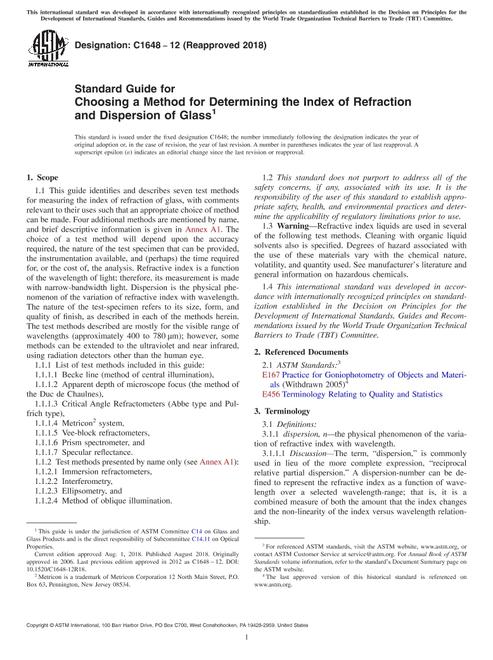
1.1This guide identifies and describes seven test methods for measuring the index of refraction of glass, with comments relevant to their uses such that an appropriate choice of method can be made. Four additional methods are mentioned by name, and brief descriptive information is given in Annex A1. The choice of a test method will depend upon the accuracy required, the nature of the test specimen that can be provided, the instrumentation available, and (perhaps) the time required for, or the cost of, the analysis. Refractive index is a function of the wavelength of light; therefore, its measurement is made with narrow-bandwidth light. Dispersion is the physical phenomenon of the variation of refractive index with wavelength. The nature of the test-specimen refers to its size, form, and quality of finish, as described in each of the methods herein. The test methods described are mostly for the visible range of wavelengths (approximately 400 μm to 780 μm); however, some methods can be extended to the ultraviolet and near infrared, using radiation detectors other than the human eye.
1.1.1List of test methods included in this guide:
1.1.1.1Becke line (method of central illumination),
1.1.1.2Apparent depth of microscope focus (the method of the Duc de Chaulnes),
1.1.1.3Critical Angle Refractometers (Abbe type and Pulfrich type),
1.1.1.4Metricon2 system,
1.1.1.5Vee-block refractometers,
1.1.1.6Prism spectrometer, and
1.1.1.7Specular reflectance.
1.1.2Test methods presented by name only (see Annex A1):
1.1.2.1Immersion refractometers,
1.1.2.2Interferometry,
1.1.2.3Ellipsometry, and
1.1.2.4Method of oblique illumination.
1.2This standard does not purport to address all of the safety concerns, if any, associated with its use. It is the responsibility of the user of this standard to establish appropriate safety, health, and environmental practices and determine the applicability of regulatory limitations prior to use.
1.3Warning-Refractive index liquids are used in several of the following test methods. Cleaning with organic liquid solvents also is specified. Degrees of hazard associated with the use of these materials vary with the chemical nature, volatility, and quantity used. See manufacturer's literature and general information on hazardous chemicals.
1.4This international standard was developed in accordance with internationally recognized principles on standardization established in the Decision on Principles for the Development of International Standards, Guides and Recommendations issued by the World Trade Organization Technical Barriers to Trade (TBT) Committee.
Product Information
Published:
07/01/2023
Pages:
15
File Size:
1 file , 560 KB
Language:
English
Note:
This product is unavailable in Russia, Ukraine, Belarus